
Trees
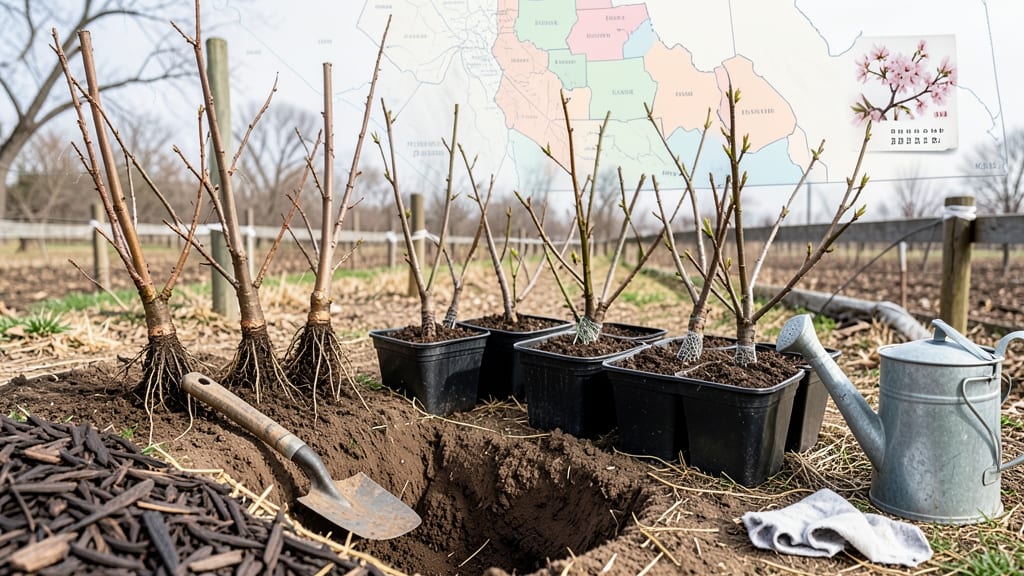
Timing your fruit tree planting in Utah could mean the difference between a thriving orchard and a frost-killed disappointment—especially with the state’s dramatic microclimates. Whether you’re in the Wasatch Front’s cooler valleys or Southern Utah’s warmer deserts, getting it right matters more than you might think.
I’ve dug into the data to uncover the exact windows when soil temperatures and frost risks align for success, so you can avoid common mistakes that waste time and money.
Utah’s 5 distinct microclimates create wildly different conditions—what works in Cache Valley’s Zone 6 might fail in San Juan County’s Zone 8. The key isn’t just following a generic calendar but understanding your specific elevation and last-frost dates.
I’ll break down the science behind these variations, so you can plant with confidence and watch your trees grow strong from day one.
Ready to skip the guesswork? You’ll discover how to check soil warmth, adjust for unpredictable spring weather, and even container-grow fruit trees if your yard isn’t ideal.
With Utah State University’s research backing these methods, you’ll learn the 3-step process to maximize survival rates—no matter where you live in the state. Let’s get those roots in the ground at the perfect moment.
From apple varieties that handle cold snaps to peaches that thrive in heat, I’ll share the best fruit trees for Utah’s unique conditions. You’ll also get a checklist to verify frost-free conditions and tips for alkaline soil prep.
By the end, you’ll know exactly when to plant—and how to give your trees the best shot at a bountiful harvest.
Utah’s microclimates: the exact planting windows by Zone and elevation
Utah’s dramatic elevation changes—from 4,000 feet in Salt Lake City to over 10,000 feet in the Uinta Mountains—create 5 distinct microclimates, each with its own last-frost dates and planting deadlines. Ignoring these can leave your fruit trees vulnerable to late spring frosts or summer heat stress.
Let’s break down the best times to plant by region, including adjustments for bare-root vs. container-grown trees.
For Wasatch Front gardeners (Zones 6-7), the optimal planting window is mid-April to early May, when soil temperatures hit 45°F (7°C). This aligns with Utah State University’s frost-free averages of May 10–20 for Salt Lake City.
However, elevations above 6,000 feet (like Park City) may delay planting by 2–3 weeks due to slower soil warming.
Southern Utah’s desert regions (Zones 7-8), including St. George and Cedar City, offer a longer window: late March to mid-April. Here, minimal frost risk after March 15 means you can plant earlier, but avoid mid-May to prevent summer drought stress during establishment.
Cache Valley (Zone 6) sits in a unique transition zone—plant bare-root trees in early April and container-grown trees by late April. The valley’s cold air pooling makes late frosts likely, so monitor local forecasts via the National Weather Service’s Logan office for updates.
Northern Utah’s San Juan County (Zone 5) and Duchesne County (Zone 6) require patience: aim for late April to early May, when soil temperatures stabilize above 50°F (10°C).
These areas often see late May frosts, so delay planting stone fruits (peaches, cherries) until mid-May to reduce risk.
Container-grown trees deserve special attention—their established root systems let you plant 2–3 weeks later than bare-root varieties. For example, in Zone 6 (Wasatch Front), you can safely plant container-grown apple trees in mid-May, while bare-root trees need to go in by early May. This flexibility is critical for high-elevation sites where soil thaws slowly.
Soil temperature is your best guide: use a soil thermometer to confirm 45°F (7°C) for apples and 50°F (10°C) for peaches. In Utah’s alkaline soils, amend with compost and sulfur to lower pH (ideal: 6.0–7.0) before planting. This prep work can shave 1–2 weeks off your planting timeline by improving root establishment.
Pro tip: Mark your calendar for the Utah State University Extension’s frost alerts (available via their [website](https://extension.usu.edu)). Their localized data accounts for Utah’s microclimate quirks, like the Wasatch Front’s urban heat island effect, which can delay last frosts by 3–5 days compared to rural areas.
For dwarf varieties (like ‘Columnar’ apples), plant 1–2 weeks earlier than standard trees—their compact root zones establish faster. Conversely, stone fruits (peaches, plums) need warmer soil, so delay planting until mid-May in Zone 6 to avoid root rot from cold, wet soils.
Remember: Elevation adjustments are non-negotiable. A 1,000-foot increase in elevation roughly equals one USDA zone shift. So if you’re planting in Heber Valley (6,500 ft),
How to adjust planting dates for Utah’s unpredictable spring weather
Utah’s spring weather can be as unpredictable as a desert mirage—one day warm enough to plant, the next hit with a surprise frost. That’s why I always check the 7-day forecast and soil temperature before digging in.
The key is planting when roots can establish without freezing, which usually means waiting until after the average last frost date for your area. For the Wasatch Front, that’s typically mid-April to early May, while Southern Utah’s desert regions can start as early as late March.
But timing isn’t just about the calendar—it’s about root growth readiness. Bare-root trees need 4-6 weeks to establish roots before winter, so I plant them by late August to early September in Utah’s cooler zones.
Container-grown trees, however, are more flexible and can go in as late as June, as long as the soil stays consistently warm. The trick is monitoring the soil temperature with a thermometer; aim for 50°F (10°C) or warmer at a 4-inch depth.
🌱 Key Takeaway: Utah’s Planting Deadlines by Tree Type
Late August–Early September
Mid-April–June (after last frost)
Early April–Mid-May (soil warm & settled)
If you’re in a high-risk frost zone like the Wasatch Front, consider using row covers or windbreaks to protect young trees. I’ve had success with frost cloth draped over trees during late spring nights, especially for peaches and cherries, which are particularly sensitive to cold snaps.
For container-grown trees, the 7-day rule applies: if no frost is forecasted for the next 7 days, it’s safe to plant. This gives roots time to adjust before any late-season chills.
Don’t forget to mulch heavily after planting to insulate roots from temperature swings. I use 4-6 inches of straw or wood chips around the base of the tree, keeping it 2-3 inches away from the trunk to prevent rot.
This extra layer can make the difference between a tree that thrives and one that struggles in Utah’s alkaline, fast-draining soils. For added protection, I also water deeply once a week during the first growing season to encourage root growth.
For those in Southern Utah’s desert regions, where nights can still dip below freezing even in May, I recommend planting heat-tolerant varieties like Desert King peaches or Santa Rosa plums. These varieties handle Utah’s hot days and cool nights better than traditional fruit trees.
If you’re unsure about your local microclimate, check the Utah State University Extension’s frost maps or use a home weather station to track conditions in your yard.
Finally, always have a backup plan. If an early frost threatens, I’ve used circulation fans or even Christmas lights to gently warm the air around young trees.
The goal is to give your fruit trees the best possible start—because in Utah, one wrong move can mean the difference between a bountiful harvest and a sad, frost-nipped sapling.